Last updated: September 2026 | MySleepWire.com Sleep Health Guide
Sleep affects far more than how energetic you feel the next morning.
A good night’s sleep supports memory, concentration, mood, physical recovery and cardiovascular health. Yet millions of adults regularly struggle to get enough sleep or wake up feeling rested. Recent U.S. data, for example, found that 30.5% of adults slept fewer than seven hours per night on average in 2024.
The good news is that improving sleep doesn’t necessarily require a complicated routine or expensive sleep technology.
Small, consistent changes to your sleep schedule, morning light exposure, caffeine intake, exercise, evening routine and bedroom environment can make a meaningful difference.
But there’s an important distinction: healthy sleep habits can support better sleep, while persistent or chronic insomnia may require targeted treatment such as cognitive behavioral therapy for insomnia (CBT-I). The American Academy of Sleep Medicine identifies CBT-I as a first-line evidence-based treatment for chronic insomnia.
So, how do you improve sleep quality?
Here is a practical 10-step approach.
What Is Good Sleep Quality?
Sleep quality isn’t simply about spending eight hours in bed.
Healthy sleep generally means that you:
- Fall asleep without excessive difficulty
- Stay asleep for most of the night
- Wake up without repeated prolonged awakenings
- Get enough total sleep for your needs
- Wake feeling reasonably refreshed
- Function well during the day
For most adults, getting at least seven hours of sleep per night is an important baseline recommendation.
However, sleep quality and sleep quantity are closely connected. You can spend eight hours in bed and still experience poor-quality sleep if your sleep is repeatedly interrupted.
10 Steps to Improve Your Sleep Quality
1. Wake Up at the Same Time Every Day
One of the simplest ways to improve sleep is to make your wake-up time consistent.
Try to wake up at approximately the same time every day, including weekends.
Why?
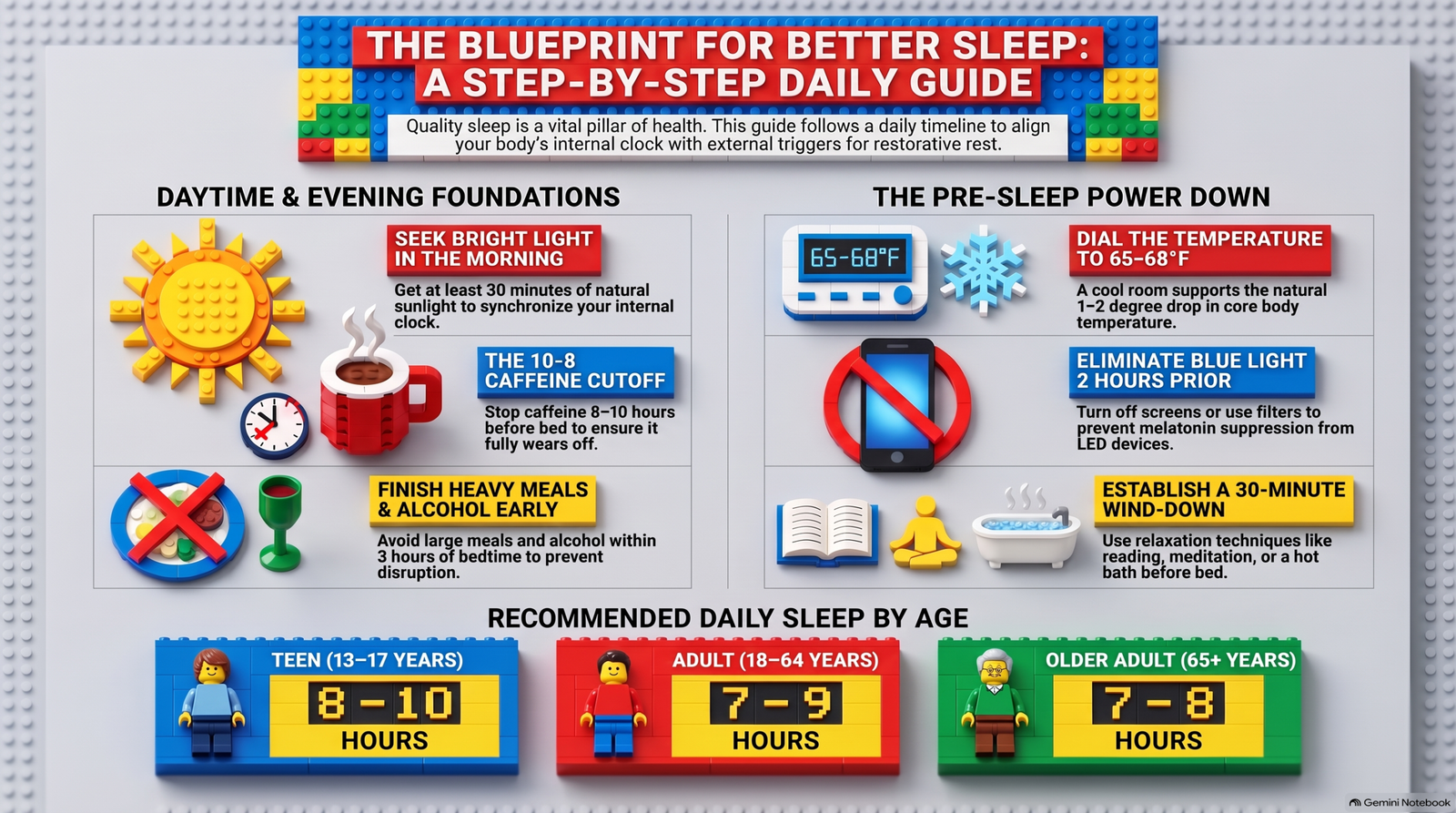
Your body operates according to a circadian rhythm—a roughly 24-hour biological timing system influenced strongly by environmental cues such as light.
A consistent schedule gives your body a predictable signal for when to be awake and when to prepare for sleep.
Try this: Choose a realistic wake-up time and maintain it for at least several weeks rather than constantly changing your schedule.
2. Get Morning Light as Early as Possible
Light is one of the strongest signals for your circadian rhythm.
Getting natural light during the morning can help reinforce your body’s day-night timing. The CDC also recommends getting natural light, particularly earlier in the day, as part of healthy sleep habits.
Instead of checking your phone immediately after waking:
Wake → open the curtains → step outside → get some natural light.
A morning walk can combine two sleep-supportive habits: light exposure and physical activity.
3. Exercise During the Day
Regular physical activity can support better sleep and overall health.
Aim for consistent movement throughout the week—walking, cycling, strength training, running, swimming or another activity you enjoy.
The CDC recommends getting physical activity during the day while avoiding exercise too close to bedtime if it interferes with sleep.
You don’t need a perfect workout plan.
Consistency matters more than intensity.
Sleep-friendly idea:
Morning walk + daytime exercise + evening wind-down.
4. Set a Caffeine Cutoff Time
That afternoon coffee might be affecting your sleep more than you realize.
Caffeine blocks adenosine receptors involved in sleep pressure and can remain active in the body for hours.
Research cited by the American Academy of Sleep Medicine found that caffeine consumed even six hours before bedtime can significantly reduce sleep time.
For people who are particularly sensitive to caffeine, an earlier cutoff may be useful.
A simple rule:
If you sleep at 10:30 p.m., consider making early afternoon your caffeine cutoff.
Remember that caffeine isn’t limited to coffee. It can also be found in:
- Tea
- Energy drinks
- Pre-workout products
- Cola
- Chocolate
- Some medications
5. Be Strategic With Naps
Napping isn’t necessarily bad for sleep.
The problem is that long or late naps can reduce your sleep drive at night.
If you need a nap, keep it relatively short and avoid taking it late in the day if it makes nighttime sleep more difficult.
If you’re regularly relying on long naps because you are exhausted during the day, that’s worth paying attention to.
Persistent daytime sleepiness can sometimes indicate insufficient sleep or an underlying sleep disorder.
6. Create a 30–60 Minute Wind-Down Routine
Your brain doesn’t have an instant “off switch.”
Give yourself a transition period between daytime activity and sleep.
A simple bedtime routine could include:
60 minutes before bed:
Dim the lights and finish demanding work.
30 minutes before bed:
Put away stimulating devices.
15 minutes before bed:
Read, stretch, breathe slowly or listen to calming music.
Bedtime:
Go to bed when you feel sleepy.
Relaxation techniques such as breathing exercises and meditation are among the behavioral approaches used in insomnia treatment.
The goal isn’t to create a perfect ritual.
It’s to create predictability.
7. Make Your Bedroom a Sleep-Friendly Environment
Your bedroom should communicate one simple message to your brain:
It’s time to sleep.
Focus on four things:
Keep it dark
Minimize unnecessary light from windows, electronics and indicator lights.
Keep it quiet
Reduce external noise where possible. Earplugs or white noise may help some people.
Keep it comfortably cool
A bedroom that feels too hot can make sleep uncomfortable.
Make your bed comfortable
Your mattress, pillow and bedding should support comfortable sleep rather than create pressure points, overheating or discomfort.
The AASM’s sleep recommendations similarly emphasize a bedroom that is quiet, dark and comfortably cool.
8. Reduce Screens and Bright Light Before Bed
Late-night scrolling can keep your brain engaged when you’re trying to wind down.
Phones and laptops can also expose you to bright light, while the content itself—social media, news, work messages or stimulating videos—can increase mental alertness.
Instead of relying exclusively on blue-light-blocking settings, consider reducing overall evening stimulation.
Try:
Dim lights → stop work → put phone away → relaxing activity → bed.
If completely eliminating screens isn’t realistic, reduce brightness and avoid highly stimulating content during the final part of your evening.
9. If You Can’t Sleep, Don’t Fight the Bed
Here’s one of the most useful strategies for people who regularly lie awake at night.
If you’re awake and becoming increasingly frustrated, get out of bed and do something quiet and relaxing until you feel sleepy again.
For example:
- Read a paper book
- Practice slow breathing
- Sit somewhere dimly lit
- Listen to calm audio
Then return to bed when you’re sleepy.
This approach is part of stimulus-control strategies used in CBT-I, which aim to strengthen the association between your bed and sleep rather than prolonged wakefulness.
The goal isn’t to obsessively watch the clock.
In fact, constantly checking the time can make nighttime anxiety worse.
10. Know When Poor Sleep Needs Professional Help
Sometimes better sleep habits aren’t enough.
Speak with a healthcare professional if sleep problems persist or significantly affect your daily life.
Pay particular attention if you:
- Frequently struggle to fall asleep
- Regularly wake during the night
- Wake much earlier than intended
- Feel excessively sleepy during the day
- Snore loudly
- Experience pauses in breathing during sleep
- Wake gasping or choking
- Regularly wake with headaches or extreme fatigue
- Have persistent difficulty functioning during the day
Chronic insomnia is more than simply having a few bad nights. AASM describes chronic insomnia disorder as persistent sleep difficulty accompanied by daytime impairment, occurring at least three times per week for at least three months.
For chronic insomnia, CBT-I—not sleep hygiene alone—is considered a first-line evidence-based treatment.
A Simple Sleep Schedule You Can Try Tonight
You don’t need to change everything at once.
Try this basic routine:
| Time | Sleep-supportive habit |
|---|---|
| Morning | Wake at the same time |
| Morning | Get natural light |
| Daytime | Exercise and stay active |
| Afternoon | Begin limiting caffeine |
| Evening | Finish your main meal earlier |
| 1 hour before bed | Start winding down |
| 30 minutes before bed | Reduce screens and bright light |
| Bedtime | Go to bed when sleepy |
| During the night | If wide awake, leave bed temporarily |
| Morning | Repeat the schedule |
The objective isn’t perfection.
It’s consistency.
The Biggest Sleep Mistakes to Avoid
If you’re trying to improve your sleep, watch out for these common habits:
❌ Sleeping at completely different times every day
❌ Drinking caffeine late in the afternoon or evening
❌ Spending hours scrolling in bed
❌ Working from your bed
❌ Going to bed before you’re actually sleepy
❌ Watching the clock throughout the night
❌ Using alcohol as a sleep aid
❌ Taking long, late naps
❌ Ignoring persistent snoring or breathing problems
❌ Treating chronic insomnia with sleep-hygiene tips alone
How Long Does It Take to Improve Sleep Quality?
There is no universal timeline.
Some people notice improvements after changing their schedule or evening habits, while others need a more structured approach.
If you’ve had persistent insomnia, don’t assume that trying more and more sleep hacks will necessarily solve the problem.
Chronic insomnia often requires targeted behavioral treatment. CBT-I addresses sleep-related behaviors and thoughts through techniques including stimulus control, sleep restriction, cognitive therapy and relaxation strategies.
Think of better sleep as a system, not a single trick.
Your morning light affects your circadian timing.
Your daytime activity affects sleep pressure.
Your caffeine intake can influence nighttime alertness.
Your evening routine affects arousal.
Your bedroom environment affects comfort.
And your response to nighttime wakefulness can reinforce either sleep or wakefulness.
Frequently Asked Questions About Better Sleep
What is the fastest way to improve sleep quality?
Start with the basics: keep a consistent wake-up time, get morning light, exercise during the day, limit late caffeine and establish a relaxing evening routine.
How can I fall asleep faster?
Go to bed when you’re sleepy, reduce stimulating activities before bed and keep your bedroom dark, quiet and comfortable. If you remain awake and frustrated, get out of bed temporarily and return when you’re sleepy.
How can I sleep through the night?
Consistent sleep timing, appropriate daytime activity, limiting late caffeine and creating a comfortable sleep environment can help. Frequent awakenings may also have an underlying cause that deserves professional evaluation.
Is 7 hours of sleep enough?
Seven hours is an important minimum recommendation for most adults, but individual sleep needs vary. The goal is enough sleep to support healthy daytime functioning.
Does morning sunlight help sleep?
Morning light is an important circadian signal and can help reinforce the timing of your sleep-wake cycle. Getting natural light earlier in the day is recommended as part of healthy sleep habits.
How late should I stop drinking coffee?
There isn’t one perfect cutoff for everyone, because caffeine sensitivity varies. However, evidence shows that caffeine consumed even six hours before bedtime can disrupt sleep, so people with sleep difficulties may benefit from stopping earlier.
Is sleep hygiene enough to treat insomnia?
Not necessarily. Sleep hygiene can support healthy sleep, but the AASM states that it should not be considered a stand-alone treatment for chronic insomnia. CBT-I is a first-line evidence-based treatment.
The MySleepWire Sleep Checklist
Before you go to bed tonight, ask yourself:
☐ Did I wake up at a consistent time?
☐ Did I get natural light during the morning?
☐ Did I stay physically active today?
☐ Did I stop caffeine early enough?
☐ Did I avoid a long or late nap?
☐ Did I give myself time to wind down?
☐ Is my bedroom dark, quiet and comfortable?
☐ Did I reduce stimulating screen use before bed?
☐ Am I going to bed because I’m sleepy—not simply because the clock says so?
☐ If sleep problems persist, have I considered speaking with a healthcare professional?
You don’t need to get every box right.
Start with one or two changes and build from there.
Final Takeaway: Better Sleep Starts Before Bedtime
Improving sleep quality isn’t about finding one magical sleep hack.
It’s about creating the conditions that allow your body’s natural sleep processes to work effectively.
Wake consistently.
Get morning light.
Move during the day.
Watch your caffeine.
Wind down at night.
Keep your bedroom sleep-friendly.
Don’t fight wakefulness in bed.
And seek professional help when persistent sleep problems go beyond simple lifestyle issues.
Sleep isn’t wasted time.
It’s biological maintenance.
And improving it may be one of the most valuable changes you make for your health, performance and everyday life.
Medical disclaimer
This article is intended for general educational purposes and is not a substitute for professional medical advice, diagnosis or treatment. Persistent insomnia, excessive daytime sleepiness, loud snoring, breathing pauses during sleep or other concerning symptoms should be discussed with a qualified healthcare professional.
Sources
The recommendations above have been aligned with current guidance and evidence from organizations including the CDC and American Academy of Sleep Medicine. Trillion Dollar Sleep Debt Trillion Dollar Sleep Debt
Download the checklist
Here is the list of sources in your notebook along with their corresponding links:
- Top 15 Tips to Sleep Better at Night – Healthline
- Link: Healthline Article
- About Sleep – CDC
- Link: CDC About Sleep Guide
- Best Temperature For Sleep: The Science Behind Optimal Rest (2026) – Doctronic
- Link: Doctronic Website
- Sleep physiology, pathophysiology, and sleep hygiene – PubMed
- PubMed Link: PubMed Entry (PMID: 36841492)
- DOI Link: https://doi.org/10.1016/j.pcad.2023.02.005
- The negative effects of blue light from digital screens in interior spaces and its impact on sleep
- Your Guide to Healthy Sleep – National Heart, Lung, and Blood Institute (NHLBI)
- Link: NHLBI Sleep Resources