1. Executive Summary: A Growing National Challenge
Sleep deprivation in the United Kingdom is increasingly being recognized as more than an individual lifestyle problem. Its effects extend into the economy, healthcare system, workplace productivity, public safety and health inequalities.
Poor sleep affects cognitive performance, physical functioning and emotional wellbeing. When insufficient sleep becomes widespread across a population, the consequences can accumulate into measurable economic and public-health costs.
An analysis of economic, clinical and epidemiological evidence points to three interconnected challenges: an economic deficit, driven by lost productivity and reduced workforce capacity; a primary-care deficit, caused by gaps in diagnosis and access to treatment; and a health-equity deficit, in which environmental and socioeconomic conditions contribute to unequal sleep outcomes.
Several indicators illustrate the scale of the issue:
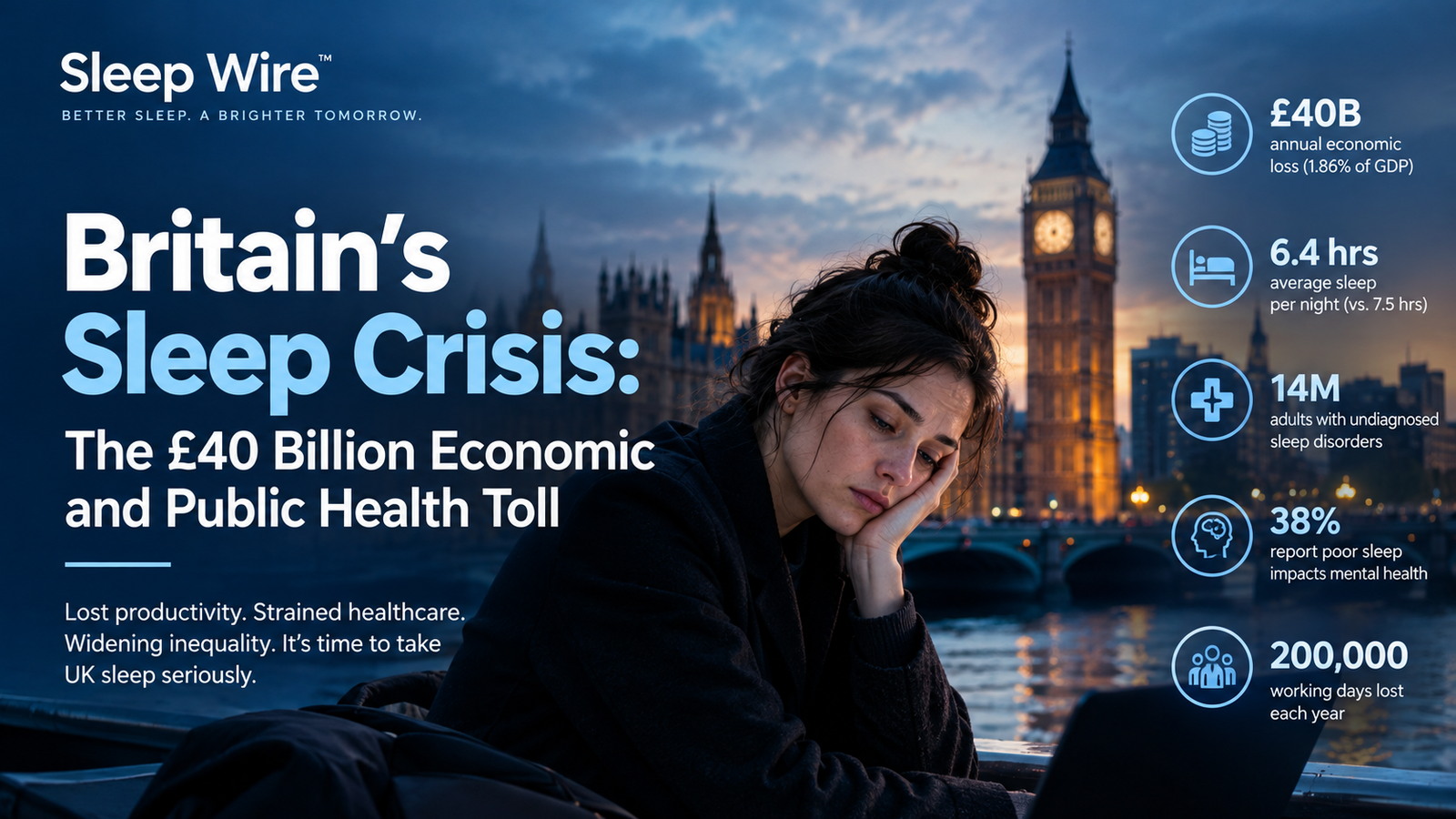
- Economic impact: Sleep deprivation is estimated to cost the UK economy as much as £40 billion annually, equivalent to approximately 1.86% of GDP, while around 200,000 working days are lost each year through absenteeism and presenteeism.
- National sleep deficit: UK adults average approximately 6.4 hours of sleep per night, compared with a cited healthy target of 7.5 hours. This amounts to an estimated 22 billion hours of lost sleep each year and an average weekly shortfall of more than eight hours.
- Undiagnosed sleep disorders: An estimated 14 million UK adults may be living with undiagnosed sleep disorders, including chronic insomnia and obstructive sleep apnoea (OSA). Around 69% of people experiencing sleep problems reportedly never consult a healthcare professional, with some waiting an average of six years before receiving clinical support.
- Mental-health effects: 38% of adults report that poor sleep negatively affects their mental health at least once a week, while 14%—approximately one in seven—report having no good nights of sleep during a typical week.
Together, these figures show that sleep loss is not confined to the bedroom. It can affect economic output, workforce performance, healthcare demand and population wellbeing.
2. The Economic and Productivity Cost of Sleep Deprivation
The economic consequences of insufficient sleep become clearer when sleep is considered as a component of workforce capacity.
Adequate sleep supports executive function, memory, motor coordination and emotional regulation. Persistent sleep restriction can therefore affect how effectively people perform their jobs. When these effects occur across a large working population, individual reductions in performance can translate into broader productivity losses.
Research by RAND Europe, cited in Why Sleep Matters, estimates that sleep deprivation costs the UK economy up to £40 billion every year, equivalent to approximately 1.86% of GDP.
The analysis also estimates that approximately 200,000 working days are lost annually. These losses occur through two principal mechanisms.
Absenteeism occurs when workers are unable to attend work because of illness, exhaustion or other consequences associated with poor sleep.
Presenteeism occurs when employees are physically present but are operating below their normal cognitive or physical capacity.
Sleep duration is also associated with health risks. The cited evidence reports that people sleeping fewer than six hours per night have a 13% higher mortality risk than those sleeping seven to nine hours, while people sleeping six to seven hours have a 7% higher risk.
Economic modelling cited in the source material suggests that if workers currently sleeping fewer than six hours increased their sleep to six or seven hours per night, the UK economy could potentially recover approximately £24 billion annually.
Population-level survey data provides further context. A Curaleaf Clinic/OnePoll study estimates that UK adults collectively lose around 22 billion hours of sleep each year. With average sleep duration at approximately 6.4 hours compared with the cited 7.5-hour benchmark, the average adult experiences a weekly deficit of more than eight hours.
Almost half of UK adults reportedly consider themselves sleep deprived, with the proportion rising among people living with physical or mental health conditions. Around one in four adults reportedly sleeps fewer than five hours per night.
The economic implications therefore extend beyond a single productivity statistic. They encompass workforce participation, concentration, workplace performance, health-related absence and the longer-term costs associated with poor health.
Table 1: UK Sleep and Economic Baseline
| Indicator | Healthy/Recommended Baseline | Current UK Reality |
|---|---|---|
| Average daily sleep | 7.5 hours; healthy adult range of 7–9 hours | 6.4 hours |
| Weekly sleep deficit | No significant deficit | More than 8 hours per person |
| Economic impact | No productivity loss attributable to sleep deprivation | Up to £40 billion / 1.86% of GDP |
| Working days lost | 0 under optimal conditions | Approximately 200,000 |
| Mortality risk | Baseline | +13% below 6 hours; +7% at 6–7 hours |
| Adults sleeping fewer than 5 hours | 0% | Approximately 25% |
| Weekly mental-health disruption | No disruption associated with inadequate sleep | 38% of adults report weekly impact |
These figures establish the scale of the economic burden, but they also raise a second question: how effectively is the healthcare system identifying and treating people whose sleep problems have become chronic?
3. The Undiagnosed Sleep Problem and NHS Treatment Gaps
Sleep problems are frequently presented to primary care through symptoms such as fatigue, poor concentration, mood changes and reduced daily functioning. Yet many underlying sleep disorders remain unidentified.
One contributing factor is the normalization of poor sleep. When persistent tiredness becomes viewed as an unavoidable consequence of modern life, both patients and healthcare professionals may be less likely to treat it as a potential clinical problem.
According to the cited Sleep Charity data, approximately 90% of UK adults report experiencing sleep problems, while an estimated 14 million adults may be living with undiagnosed sleep disorders, including chronic insomnia and obstructive sleep apnoea.
The gap between symptoms and professional support is substantial. Around 69% of people experiencing sleep problems reportedly have never consulted a healthcare professional, while those who eventually seek help may have experienced symptoms for an average of six years.
The Mental Health Foundation data cited in the report also indicates that 38% of adults have never taken self-management or therapeutic action to improve their sleep. Meanwhile, 34% report that worry and stress reduce their sense of control over their sleep.
Treatment access presents another challenge.
The National Institute for Health and Care Excellence (NICE) recommends Cognitive Behavioural Therapy for Insomnia (CBT-I) as the first-line treatment for chronic insomnia. However, Freedom of Information data gathered by The Sleep Charity from 132 responding NHS Trusts in England reportedly found that only 17 trusts—approximately 12%—offered both face-to-face and digital CBT-I services.
This creates what the source describes as a potential postcode lottery, where access to treatment may depend on where a patient lives.
Digital-only pathways can also create barriers. House of Lords data cited in the report indicates that approximately 7 million UK households lack internet access, while around 4 million adults lack basic digital skills. This raises concerns that digital-only treatment options could be less accessible to older people, lower-income households and other digitally excluded groups.
The report also identifies gaps in medical education and professional training around sleep medicine.
These shortcomings can create a difficult cycle. Limited access to non-pharmacological treatment may increase reliance on medication, while insufficient clinical training can make the identification and management of sleep disorders more difficult.
The source material reports that prescriptions for insomnia medication reached approximately 1 million in 2023, while prescriptions for sleeping medication among children reportedly tripled over a seven-year period.
The result is a healthcare challenge that extends beyond diagnosis: ensuring that evidence-based treatment is available consistently and equitably across the country.
4. The Sleep Gap: Inequality, Housing and the Environment
Sleep does not occur in isolation from the conditions in which people live.
Housing, income, employment, neighbourhood conditions and exposure to environmental stressors can all influence a person’s ability to obtain consistent and restorative sleep.
Research from Nottingham Trent University and the University of Roehampton, using UK Biobank data covering approximately 500,000 adults aged 40 to 69, found associations between neighbourhood deprivation and poorer sleep outcomes.
People living in highly deprived areas were more likely to report problems including frequent night-time waking, difficulty waking, daytime sleepiness and non-restorative sleep.
The research linked these differences to environmental conditions including overcrowding, traffic noise, light pollution and poor air quality.
The researchers also developed a Problematic Sleep Index, designed to combine environmental and physiological sleep indicators into a single screening measure. The concept could potentially support community healthcare, local public-health planning and social-housing assessments by helping identify areas where sleep-related problems are concentrated.
The demographic profile associated with better sleep in the cited Biobank analysis was predominantly male, younger, more affluent, degree educated, living with others and living in owner-occupied housing with higher household income and stable employment.
The analysis also identified differences in reported ability to wake feeling refreshed. The figures cited in the source show:
- 82.4% of White adults
- 74.4% of Black adults
- 73.5% of Asian adults
- 74.2% of mixed-ethnicity adults
reported finding it easy to wake refreshed in the morning.
Economic pressure adds another layer to the UK’s sleep inequality.
A King’s College London/ESRC study cited in the report found that 60% of Britons reported negative mental-health effects from the cost-of-living crisis, while 23% reported losing sleep because of financial anxiety.
Housing tenure also appears to be associated with sleep disruption. Around 39% of social-housing tenants reportedly lost sleep over rising costs, compared with 15% of outright homeowners.
Among households relying on borrowing or savings to meet essential expenses, psychological distress was particularly high, with 60% of those borrowing money reporting above-average psychological distress.
The sleep gap is also visible in institutional settings.
A Care England and Ally Cares white paper covering more than 5,000 care-home residents identified a significant institutional sleep deficit. Residents were reportedly often receiving fewer than five hours of uninterrupted sleep because of nighttime care routines and noise.
The consequences identified in the source include increased falls, infection susceptibility, malnutrition, cognitive decline and potentially preventable emergency hospital admissions.
Taken together, these findings suggest that sleep inequality is influenced not only by individual behaviour, but also by the environments in which people live, work and receive care.
5. Public Safety and the Long-Term Health Consequences
The consequences of chronic sleep deprivation extend beyond fatigue.
On UK roads, driver fatigue is estimated by POST Parliament to account for approximately 20% of road traffic accidents.
Sleep deprivation can impair attention, reaction time, decision-making and executive processing. The source material cites laboratory research indicating that 24 hours without sleep can produce cognitive impairment comparable to a blood alcohol concentration of 0.06%.
Untreated obstructive sleep apnoea represents another public-safety concern. The report estimates that approximately 1.5 million Britons are affected by OSA and cites evidence associating untreated OSA with a substantially higher risk of road traffic accidents.
Sleep deprivation can also influence behaviour and emotional regulation.
Data from The Sleep Charity cited in the report indicates that:
- 4% of adults report becoming physically aggressive or violent when unable to sleep.
- 10% report emotional aggression toward family members or colleagues.
- 5% report driving while severely fatigued.
- 13% report using alcohol as a sleep aid.
- 24% report eating more unhealthy, calorie-dense food.
- 21% report paranoid, anxious or depressive thoughts during periods of prolonged wakefulness.
The psychological burden is similarly significant.
The Mental Health Foundation data cited in the report suggests that the average UK adult experiences only three good nights of sleep per week, while 14% report having zero good sleep days in a typical week.
Around 34% of adults report that worry and stress reduce their control over sleep.
Over a one-month period, 48% of adults reportedly experienced anxiety, stress, feeling overwhelmed or irritability because of sleep loss. Among working adults, 33% reported reduced concentration at work, while 22% acknowledged making work mistakes.
The relationship between sleep and long-term health is also important. Evidence summarized by POST Parliament links chronic short sleep with processes including systemic inflammation, neuroendocrine disruption and altered glucose metabolism.
Over time, persistent sleep restriction has been associated with higher risks of conditions including cardiovascular disease, obesity, type 2 diabetes and impaired immune function, alongside reduced life expectancy.
Sleep deprivation therefore has consequences that can accumulate across individual health, workplace safety and wider society.
6. What Should Happen Next? A Policy and Clinical Roadmap
The scale and complexity of the UK’s sleep problem suggest that isolated individual interventions may not be sufficient.
The evidence presented in this report points toward a more coordinated approach involving public health, primary care, employers, housing authorities and the social-care sector.
A national sleep strategy could position sleep alongside established public-health priorities such as diet, exercise and smoking cessation.
1. Develop a National Sleep Strategy
The UK Government should publish a dedicated national framework for sleep, building on its previous public-health commitments.
Such a strategy could establish evidence-based public guidance, improve awareness of sleep disorders and position sleep as an important component of population health.
Local authorities could also use targeted public-health funding to address environmental contributors to poor sleep in deprived communities.
Potential interventions identified in the source include light-blocking window coverings, noise-reduction materials, earplugs and eye masks for residents exposed to significant environmental noise and light pollution.
2. Expand Access to CBT-I Through Primary Care
Sleep assessment could be incorporated more systematically into primary care.
The report proposes integrating sleep screening into the NHS Making Every Contact Count (MECC) framework, allowing healthcare professionals to identify persistent sleep problems and potential underlying conditions.
The source also calls for equitable access to NICE-recommended CBT-I across NHS Trusts.
Patients should have access to both digital and face-to-face treatment options where appropriate, reducing the risk that digital exclusion becomes a barrier to care.
3. Strengthen Sleep-Medicine Education
Medical education and continuing professional development could place greater emphasis on sleep disorders, sleep architecture and evidence-based treatment.
Improved training could help clinicians distinguish routine short-term sleep disruption from conditions requiring further investigation, including chronic insomnia and obstructive sleep apnoea.
Clear non-pharmacological treatment pathways could also help reduce unnecessary dependence on medication.
4. Address Workplace Sleep and Fatigue
Employers could introduce formal Sleep Charters, workplace sleep-awareness programmes and fatigue-risk management systems.
Shift scheduling, night work, workplace stress and excessive working hours can all influence sleep opportunities and fatigue.
Managing these risks could help address absenteeism, presenteeism and occupational safety.
5. Improve Sleep Standards in Social Care
Care homes could adopt dedicated nighttime protocols designed to minimize unnecessary noise and interruptions.
The source also highlights the potential role of non-invasive monitoring and technology in reducing nighttime disturbances.
The cited material reports that certain AI-enabled care platforms have been associated with reductions in nighttime awakenings and resident falls, although such technologies would require appropriate evaluation and implementation in real-world care settings.
Conclusion: Sleep as a National Resource
Britain’s sleep problem is increasingly connected to questions that extend well beyond individual wellbeing.
Insufficient sleep can affect productivity, workplace safety, healthcare demand, mental health, chronic disease risk and social inequality.
The evidence presented in this report places the potential economic cost at up to £40 billion a year, while millions of people may be living with persistent sleep problems that remain undiagnosed or untreated.
At the same time, access to healthy sleep is not evenly distributed. Housing conditions, financial pressure, environmental exposure, employment patterns and access to healthcare can all influence sleep outcomes.
Addressing the problem therefore requires more than telling individuals to go to bed earlier.
It requires a coordinated public-health response that recognizes sleep as an important component of a productive workforce, resilient healthcare system and healthier population.
For the United Kingdom, improving sleep could represent not only a health intervention, but also an opportunity to address productivity, inequality and long-term public expenditure.
Sleep is personal—but its consequences are national.